|
|
REPORT OF THE ACSMEDI-EFMC MEDICINAL CHEMISTRY FRONTIERS 2025
Jointly organised by ACS MEDI (Division of Medicinal Chemistry of the American Chemical Society), and EFMC (European Federation for Medicinal chemistry and Chemical biology), the ACSMEDI-EFMC Medicinal Chemistry Frontiers 2025 took place in Chicago, IL, United States on May 12-15, 2025. The latest advances and current state of research in drug discovery and development were presented to about 400 attendees, among which students, academics, and industry-affiliated researchers from all over the world.
Have a look at the full event report below, written by the awardees of the YSN/YMCC Travel Grant.
A programme including nine sessions, composed of keynote and invited lectures, as well as short oral communications was proposed to the attendees. The symposium started with the Plenary Lecture of Dr Ingo Hartung (Merck, DE) on “Designing Impactful Small Molecule Drugs”. Additional plenary lectures by Prof. Paul J. Hergenrother (University of Illinois, USA) and Dr Wendy Young (Biotech Executive & Independent Board Member, USA) figured among the numerous highlights of the event.
The conference covered different aspects of medicinal chemistry, from targeted protein degradation and other new therapeutic modalities, like peptide therapeutics, to AI-driven drug design. A noticeable trend throughout both the talks and poster presentations were the growing integration of computational tools into early-stage drug discovery, enabling more efficient lead identification. The presentations and posters also covered a range of therapeutic areas, such as cancer, Alzheimer’s, and infectious diseases. Lastly, the lunch workshops offered a great opportunity to network and explore novel platforms and technologies.
The poster session sparked genuine curiosity especially with those less familiar with the concept of ferroptosis, a relatively novel form of regulated cell death (Camilla). It also provided an opportunity to present our approach to rescuing the "undruggable" tumor suppressor p53 (Dimitrios-Ilias).
The social programme included a welcome reception on the first day, a boat tour or baseball game on the second evening, and the traditional symposium banquet to conclude the event. These various networking activities provided an exceptional atmosphere for all the attendees to connect and share impressions in an informal setting.
The support from the YSN/YMCC Grant was instrumental in making our experience possible. It provided access to a vibrant international environment where we exchanged ideas and discussed the diverse challenges and opportunities currently facing the drug discovery field. We returned with fresh perspectives, new connections, and a clearer vision for the future of our scientific career. We are truly grateful for the opportunity to be part of this enriching experience.
The next edition of the ACSMEDI-EFMC Medicinal Chemistry Frontiers will take place in Dublin, Ireland on June 22-25, 2026, and the YMCC/YSN Grant will allow the participation of two US-based researchers.
Written by:
Dr Camilla Scarpellini, University of Antwerp, Belgium
Dr Dimitrios-Ilias Balourdas, Utrecht University, The Netherlands THE NEWSLETTER IS KINDLY SPONSORED BY BIODURO
ADVANCES IN STRUCTURAL ANALYSIS OF BIOMOLECULES | CELEBRATING 25 YEARS OF CHEMBIOCHEM AND CHEMPHYSCHEM
Join ChemBioChem and ChemPhysChem for their 25th Anniversary Symposium on Advances in Structural Analysis of Biomolecules, which will take place in Berlin, Germany, on October 23-24, 2025.
This exciting event will bring together scientists working at the interface between chemistry, biology, medicine, and physics, and will cover a wide variety of topics from biophysical methods, subcellular imaging to drug design, and more. The programme will include plenary and invited lectures, a selection of short communications, and a large poster session with poster prizes. There will also be many opportunities to connect and exchange ideas.
Registration deadlines
- Early bird registration: July 9, 2025
- Standard registration: from July 10, 2025
Abstract submission deadlines
- Oral Communication submissions: September 11, 2025
- Poster submission: September 11, 2025
We look forward to welcoming you to two days full of science, networking and celebrations in Berlin!
More information on CBC-CPC 2025.
LITERATURE SPOTLIGHT
The “Literature Spotlight” section of the newsletter offers concise and accessible summaries of recently published research. It highlights a range of themes drawn from various journals, with this edition’s contribution provided by Tiago Bozzola (Lead Discovery Center, Germany)
This contribution focuses on the recently published article ‘Ligand Screening and Discovery Using Cocktail Soaking and Automated Microcrystal Electron Diffraction’ by Jieye Lin, Marc J. Gallenito, Johan Hattne, and Tamir Gonen (ChemMedChem 2025, DOI: 10.1002/cmdc.202500156).
The identification of protein–ligand interactions at high resolution is a central aim in structure-based drug discovery. Advances in microcrystal electron diffraction (MicroED) now enable structural determination from microcrystals, eliminating the need for larger ones.
In this study, Lin et al. developed a workflow combining cocktail soaking of protein microcrystals (thermolysin and proteinase K) with automated MicroED to accelerate ligand screening. Microcrystals were fragmented via sonication, soaked with known ligands, and analyzed by MicroED. High-throughput data collection (7 min/crystal) allowed rapid resolution of binding sites, even for weak-affinity ligands.
Electron density maps confirmed ligand binding consistent with prior studies, though alternative poses were observed for proteinase K. By integrating cocktail soaking and automated MicroED, the authors present a platform for efficient structural screening, enabling direct visualization of ligand–protein complexes at near-atomic resolution. This approach is particularly valuable for microcrystals incompatible with X-ray diffraction.
While this study presents a promising platform that successfully integrates cocktail soaking with automated MicroED for ligand screening, broader validation across diverse protein targets and ligand classes will be essential to establish its general utility in structural drug discovery.
Read the article! MEET CLINTON VEALE, UNIVERSITY OF CAPE TOWN, SOUTH AFRICA
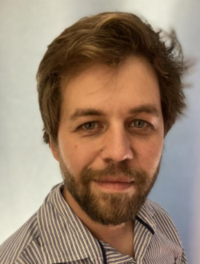
In this edition, our MedChemBioConversations is with Clinton Veale from the University of Cape Town, South Africa. Get to know thembetter by reading the interview below:
How did you get interested in Medicinal Chemistry?
I developed a general interest in the interface of organic chemistry, biology and pharmacology during my pharmacy undergraduate degree. This led me to seek specific post-graduate opportunities in this area, including an MSc in medicinal and biological chemistry at the University of Edinburgh, a PhD in organic chemistry at Rhodes University, and a Post-doctoral Fellowship at the University of Stellenbosch. These combined experiences as well as the opportunity to interact with students and academics across related disciplines helped me to develop my specific interests in chemical biology and medicinal chemistry.
Where are you currently working and what is your current position?
I am currently an Associate Professor of Organic Chemistry at the University of Cape Town.
What are your current research interests?
The main interest of our group is to apply skills in organic synthesis and biophysical chemistry (particularly native mass spectrometry) to investigate ‘difficult-to-access’ and underexplored chemical space. Examples of this include characterization and modulation of transient protein-protein interactions and small molecules, which are confined to the extracellular environment. The aim of this work is to develop creative solutions for addressing neglected diseases in Africa, particularly those without validated pharmacological targets. Our recent focus has been to develop small molecules which modulate the interaction between the Hsp90 chaperone protein, and its co-chaperone HOP as a strategy for developing inhibitors onco-viruses (e.g. KSHV).
What do you like best about your work?
I enjoy the open-ended nature of academic research. I always find it amazing, how curiosity-driven research projects don’t end up progressing exactly as you planned. Somehow, the process of conducting well executed experiments produces unexpected results and delivers different but equally important scientific insight.
What kind of skills does your work require?
Typically, our contributions to collaborative projects require skills in synthetic organic chemistry and /or analytical chemistry skills. Our group also place high value on communication, teamwork and cooperation. In addition, being able to problem-solve and figure out what is going on when ‘something weird’ happens is very important.
What do you consider your greatest achievement in your scientific career?
A few years back I was the recipient of a Royal Society Future Leaders – African Independent Research (FLAIR) Fellowship. This fellowship acted like a springboard for advancing my science and my career in general.
Which of your papers are you most proud of and why?
These would have to be the series we published on the Hsp90-HOP PPI, where we developed native mass spectrometry methods to identify PPI modulatory compounds, and further developed these to facilitate PPI interfacial characterisation. This led to a very satisfying translational result, where we demonstrated that our Hsp90-HOP PPI inhibitory compounds disrupted the activation of KSHV lytic replication, thus providing the first potential validation of this PPI as a host-based target for KSHV drug discovery. From a basic sciences perspective, it represented an important step in understanding viral interactions with the host regulatory machinery and is a key idea we are taking forward into our future chemical biology programme.
What are the features of a successful PhD student or postdoc?
Unfortunately, failure is a big part of research. Students and post-docs who are not closed books, but to seek help when it is needed, communicate success and failure to their advisors regularly and understand that failure is not a reflection on them personally, tend to be more successful.
What advice would you give to someone who wants to know more about your field?
Join the EFMC mailing list!
What would you like to ask from other medicinal chemists?
Please keep in mind that insightful science is still achievable using ‘old-school’ approaches. Particularly in resource constrained environments. Judge the actual science, not the perception.
What are your recommendations for a book, podcast, website, blog, YouTube channel or film?
I really enjoy the Naked Scientists Podcast. They are experts in distilling the essence of cutting-edge science and keeps me abreast of many different fields.
Which scientist do you admire the most and why?
Aaron Klug, and not just because he is South African. His ability to harness insights in fundamental chemistry and physics to study viral structure, is for me the essence of chemical biology.
Which field of medicinal chemistry do you consider the most promising for the future?
Medicinal chemistry and chemical biology together have made some outstanding dogma breaking progress in the last two decades. Introducing covalent warheads and the large non ‘drug-like’ molecules for proximity-based pharmacology are two particular successes. I think this dogma breaking trend will continue into host-based targets for antimicrobial drug discovery for numerous infectious pathogens.
What would you expect to be the next breakthrough in medicinal chemistry?
The role of drug design in personalised medicine will be fascinating to follow. EFMC SESSSION AT AIMECS 2025
The 15th AFMC International Medicinal Chemistry Symposium (AIMECS 2025) will take place from September 25th to 27th in Hangzhou, China.
The EFMC is happy to organise a session on “Advances in Covalent Drug Discovery or Covalent Binders in Drug Discovery”. Chaired by Prof. Gianluca Sbardella (University of Salerno, Italy), it will gather three expert speakers in the field.
- Dr Marc Grundl, Boehringer Ingelheim, Austria
- Dr Robert Pulz, Novartis, Switzerland
- Dr Uwe Grether, F. Hoffmann-La Roche, Switzerland
We look forward to meeting you at AIMEC 2025!
#MEDCHEMCASES - SEMINAR BY THE DIVISION OF MEDICINAL CHEMISTRY OF THE GERMAN CHEMICAL SOCIETY (GDCH)
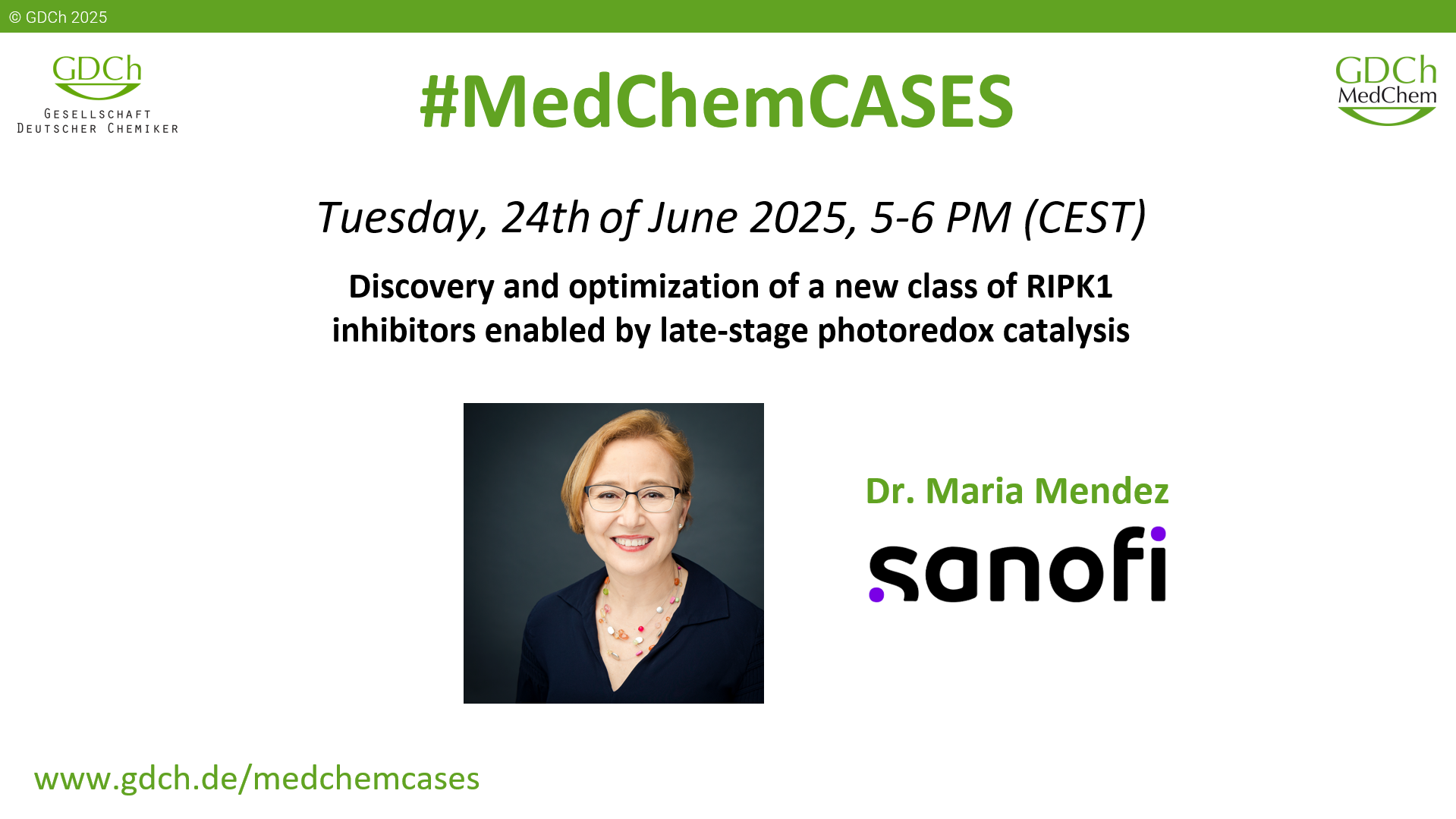
The MedChem Division of the German Chemical Society (GDCh) would like to invite you to the next #MedChemCASES online seminar which will be held on June 24 (5.00pm) by Dr María Méndez Pérez (Sanofi, Germany).
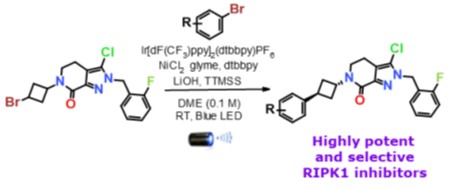
The topic of the webinar will be Discovery and Optimization of a New Class of RIPK1 Inhibitors Enabled by Late-stage Photoredox catalysis.
Receptor Interacting Protein Kinase 1 (RIPK1) plays a crucial role in regulating necroptosis and inflammation and the potential therapeutic benefits of RIPK1 inhibitors are being investigated in several clinical trials.1 ,2 We will describe the discovery and optimization of a new series of highly potent and selective RIPK1 inhibitors, that were identified by combining structure-based approaches, free-energy perturbation (FEP+) and state-of-the-art machine learning approaches for property predictions. Using X-ray crystallography, we could confirm that the inhibitors bind as allosteric type III inhibitors, thereby not contacting the kinase hinge region. We will illustrate how a C(sp3)-C(sp2) photochemical transformation was a key enabler for the efficient SAR exploration and profile optimization.
Literature:
[1] Zhang. Y. et al. Eur. J. Med. Chem. 2024, 265, 116123. Lessene, G. et al. J. Med. Chem. 2023, 66, 2361. [2] He, S., Wang, X. RIP kinases as modulators of inflammation and immunity. Nat Immunol 2018, 19, 912.
Register HERE. NEWS FROM THE MEDICINAL AND BIOLOGICAL CHEMISTRY DIVISION OF THE INSTITUTE OF CHEMISTRY OF IRELAND
The IV Medicinal & Biological Chemistry Ireland conference is organised every two years by the Division for Medicinal & Biological Chemistry of the Institute of Chemistry of Ireland (ICI), supported by the European Federation of Medicinal chemistry and Chemical biology (EFMC).
This biennial meeting is the national conference in the field of medicinal chemistry and chemical biology in Ireland with international and national speakers and participants.
This year, the conference will take place in Belfast (UK) in July 15-16, and the registration and scientific programme can be found here: https://medicinalchemistryireland.wordpress.com
Looking forward to seeing you to Belfast in July!
NEWS FROM THE FRENCH MEDICINAL CHEMISTRY SOCIETY (SOCIÉTÉ DE CHIMIE THÉRAPEUTIQUE, SCT)
The SCT reminds you not to forget the upcoming 59th International Conference on Medicinal Chemistry. SCT’s flagship conference will take place in Orléans, France on July 2-4, 2025. The congress will be devoted to "Drug Discovery and Selection" and will feature 18 plenary lectures and 6 short lectures. On top, 2 plenary lectures will be delivered by the recipients of the SCT Award for Drug Discovery Chemistry and the Evotec Prize for Excellence in Molecular Design.
In addition, a poster session will provide the opportunity for all participants to present their current results. Poster prizes will be attributed at the end of the meeting.
NEWS FROM THE SOCIETY FOR MEDICINES RESEARCH (SMR)
The SMR announces several upcoming events.
Women’s Health Meeting
Tuesday 17 June 2025, Friends House, London, UK
Registration is open!
Website: https://www.smr.org.uk/Meetings/20250617/
Overview: The SMR are delighted to be organizing our first Women’s Health meeting; Unlocking opportunities in women’s healthcare to accelerate the discovery of therapeutics for female-specific conditions beyond oncology. The women’s health space encompasses many unique challenges that require research, attention and investment. Despite such challenges, women’s healthcare presents great opportunities for value creation and more importantly improving the lives and livelihoods of women.
In this scientific one-day meeting, a panel of women’s health experts comprising leading researchers from academia, biotech and pharma will describe the journey from concept and initial research findings, through to the creation of biotech’s driving the identification of therapeutics in the fields of endometriosis, fertility & ovarian function. The meeting will include a success story from discovery to patient for post-partum haemorrhage and address conditions such as pain that affect women differently to males, highlighting the need for sex- and gender-specific approaches.
There will also be a poster session and panel discussion.
Early Career Researchers:
As part of the SMR’s support of Early Career Researchers, we will also enjoy a selected talk chosen from the poster abstracts. Please see the event website for more information.
Target Identification and Validation in Drug Discovery
Friday 24 October 2025, The Discovery Centre (DISC), AstraZeneca, Cambridge, UK
A date for your diary!
Website: https://www.smr.org.uk/Meetings/20251024/
Overview: The Society for Medicines Research (SMR) is pleased to announce an upcoming meeting focused on the topic of Target Identification and Validation in Drug Discovery.
This one-day event, to be held on Friday 24 October 2025 at the DISC (AstraZeneca) in Cambridge, will bring together experts from industry and academia to share the latest research and insights.
Attendees can expect to hear about new approaches, technologies, and success stories in the field of target discovery and validation, paving the way for the next generation of therapeutic innovations.
Recent Clinical Candidates and SMR Award Meeting
Thursday 04 December, Friends House, London, UK
A date for your diary! NEWS FROM THE BIOLOGICAL AND MEDICINAL CHEMISTRY SECTOR (BMCS) OF THE ROYAL SOCIETY OF CHEMISTRY (RSC)
The BMCS is happy to announce several upcoming events.
RSC-BMCS / SCI 23rd Medicinal Chemistry Symposium
Sunday – Wednesday, 14th-17th September, 2025, Churchill College, Cambridge, UK
Registration still open! Limited accommodation packages available!
Website: https://www.rscbmcs.org/events/cammedchem25/
Synopsis: The organisers invite you to the 23rd SCI-RSC Medicinal Chemistry symposium, Europe’s premier biennial Medicinal Chemistry event, focusing on first disclosures and new strategies in Medicinal Chemistry.
8th RSC-CICAG / RSC-BMCS Artificial Intelligence in Chemistry
Monday-Wednesday, 22nd – 24th September 2025, Churchill College, Cambridge, UK
Registration is open!
Website: https://www.rscbmcs.org/events/aichem8 /
Synopsis: Artificial Intelligence is experiencing a renaissance in the development of new methods and practical applications to ongoing challenges in Chemistry. Following the successes of six annual “Artificial Intelligence in Chemistry” meetings starting in 2018, we are pleased to announce that the Chemical Information & Computer Applications Group (CICAG) and Biological & Medicinal Chemistry Sector (BMCS) of the Royal Society of Chemistry are once again organising a conference to present the current advances in AI and machine learning in Chemistry. The meeting will be held over two and half days and combine aspects of artificial intelligence and deep machine learning methods to applications in chemistry. The programme will include a mixture of keynote talks, panel discussion, oral presentations, flash presentations, posters and opportunities for open debate, networking, and discussion. This year meeting will follow 2024 with two and half days and will include workshop on first day, please keep checking the website for updates.
BMCS New approaches to the treatment of Parkinson’s
Wednesday 12th November 2025, Burlington House, London, UK
BMCS / Parkinsons UK
Abstract Submission and registration is open! Check the website for updated speaker details!
Website: https://www.rscbmcs.org/events/parkinsons25/
Join the Royal Society of Chemistry Biological Medicinal Chemistry Sector and Parkinson’s UK to hear about new approaches to the treatment of Parkinson’s Disease.
In the dynamic field of drug discovery, the search for new treatments for Parkinson’s disease has never been more critical. It is estimated 10 million people worldwide are living with Parkinson’s – a chronic, progressive neurodegenerative condition resulting from the loss of the dopamine-containing cells of the substantia nigra. Motor and non-motor symptoms of the condition are wide ranging and current treatments only help to manage a small subset of the symptoms and do not modify the disease progression. But there is a wealth of research to find new and better therapeutics for Parkinson’s.
This meeting, specifically designed for professionals dedicated to developing new therapeutics for Parkinson’s disease, will highlight current research offering symptomatic relief and disease modifying approaches.
BMCS Hot Topics: Antibody–Drug Conjugates
Thursday 20 November 2025 (afternoon), Virtual
BMCS
Save the date!
Website: https://www.rscbmcs.org/events/hottopicsadcs2025/
The BMCS Hot Topics online meetings are intended to highlight breaking areas of research in fields of science relevant to drug discovery. They will run as stand-alone half-day virtual events, 2-3 times per year. The programme will be targeted towards researchers working who would like to enhance their understanding of these nascent or developing fields.
Antibody-drug conjugates (ADCs), alongside other targeted modalities, effectively enrich target tissues with potent payloads unsuitable for systemic administration. With several recent clinical successes, the number of new ADCs approaching the clinic is rapidly increasing. This meeting aims to highlight the technological advancements and innovations driving these ADCs, while addressing the challenges and opportunities within the field. The Hot Topics session will feature speakers from industry and academia who are at the forefront of ADC design.
|
|
|
|
|
|
ISSUE SPONSORED BY
EFMC ORGANISED EVENTS
August 31 - September 4, 2025
Porto, Portugal
X EFMC International Symposium on Advances in Synthetic and Medicinal Chemistry (EFMC-ASMC 2025)
September 4-5, 2025
Porto, Portugal
12th EFMC Young Medicinal Chemists' Symposium (EFMC-YMCS 2025)
EFMC SPONSORED EVENTS
October 6-9, 2025
Paris, France
ChemBioParis2025 – approaching biology through chemistry
October 24-25, 2025
Berlin, Germany
Advances in Structural Analysis of Biomolecules
EFMC CERTIFIFED SCHOOLS
June 29 - July 3, 2025
Urbino, Palazzo Battiferri, Italy
ESMEC School
July 15-17, 2025
Bilbao, Spain
SEQT Summer School
September 14 - 19, 2025
Department of Pharmaceutical Sciences - Vienna, Austria
Vienna Summer School
September 15-16, 2025
University of Tübingen, Tübingen, Germany
MedChemCampus2025
September 22 - 24, 2025
University of Bologna – Rimini Campus, Rimini, Italy
SSPA Summer School
JOB PORTAL
Junior research group leader
Institut Pasteur, FRANCE
Read more
Postdoctoral researcher
Pompeu Fabra University, SPAIN
Read more
PhD in Medicinal Chemistry/Chemical Biology
CNRS - Université Côte d'Azur, FRANCE
Read more
|
|